Our approach
How we teach, how we decide what to teach, and how we work out whether it is helping.
Applied Behaviour Analysis (ABA)
ABA is the study of how learning happens, and how the things around a person change what they do. Applied to teaching, it means breaking a skill into steps, working out what motivates the learner, teaching in a way that sets them up to succeed, and measuring whether it worked.
It has a reputation problem, and some of it is deserved. Early forms of ABA were rigid, prioritised compliance, and paid little attention to whether the child was happy. That is not how we practise, and it is not where the field is now.
Our starting question is always the same. What can we do to help this child be more comfortable in the world, and more able to get what they need from it?
Progressive ABA
The programme adapts to the child, rather than the child adapting to a programme.
Relationship first
Before we ask anything of a child, we spend time with them doing things they enjoy, with nothing expected in return. This is called pairing, and it is the step most often skipped. A child will not follow an instruction from an adult whose arrival predicts something unwelcome.
Led by the child
We set targets around what each child is interested in, so they are motivated to learn. If a child wants to get out into the garden, we teach them to put their own shoes on. If they keep drifting towards one particular friend, we teach them to say hello and join in. Much of the teaching then happens in play and everyday routines rather than at a table, because that is where the skills are needed.
We respect "no"
We teach children to say no, and we honour it. If a child asks for a break or to do something else, that request is respected, because a child who learns that asking works has no reason to escalate.
How this differs from other support
Schools and families often have several people involved already. What a behaviour analyst adds is specific.
We assess first
We do not start from a programme and fit the child to it. Structured assessment tells us where the child actually is, and the targets come from that.
We use structured approaches
Task analysis, chaining, prompting, shaping and reinforcement all come from behaviour analysis. Our training is in choosing the right method for the child and the skill, teaching it in the right order, and fading support so the child becomes independent.
We measure
Every target has a point at which it counts as learned, and progress is recorded rather than judged on impressions. When the data says something is not working, we change it.
We are accountable
Postgraduate training in behaviour analysis, supervised clinical practice, and registration on an accredited register with insurance, DBS checks and a published complaints procedure. What registration involves.
Teaching communication
We use the Verbal Behaviour approach, which applies the principles of ABA to language. It suits children who are not yet conversational, which describes many of the children we see.
Asking comes first. A child who can ask for food, a toy, help or a break has far less reason to get those things another way. Teaching a child to ask is one of the most common and effective interventions for behaviours of concern (Tiger, Hanley and Bruzek, 2008).
Each part of language is taught separately. Asking for a drink, naming one in a picture and answering "what do you drink from?" are three different skills. A child who can do one will not necessarily do the others until each has been taught.
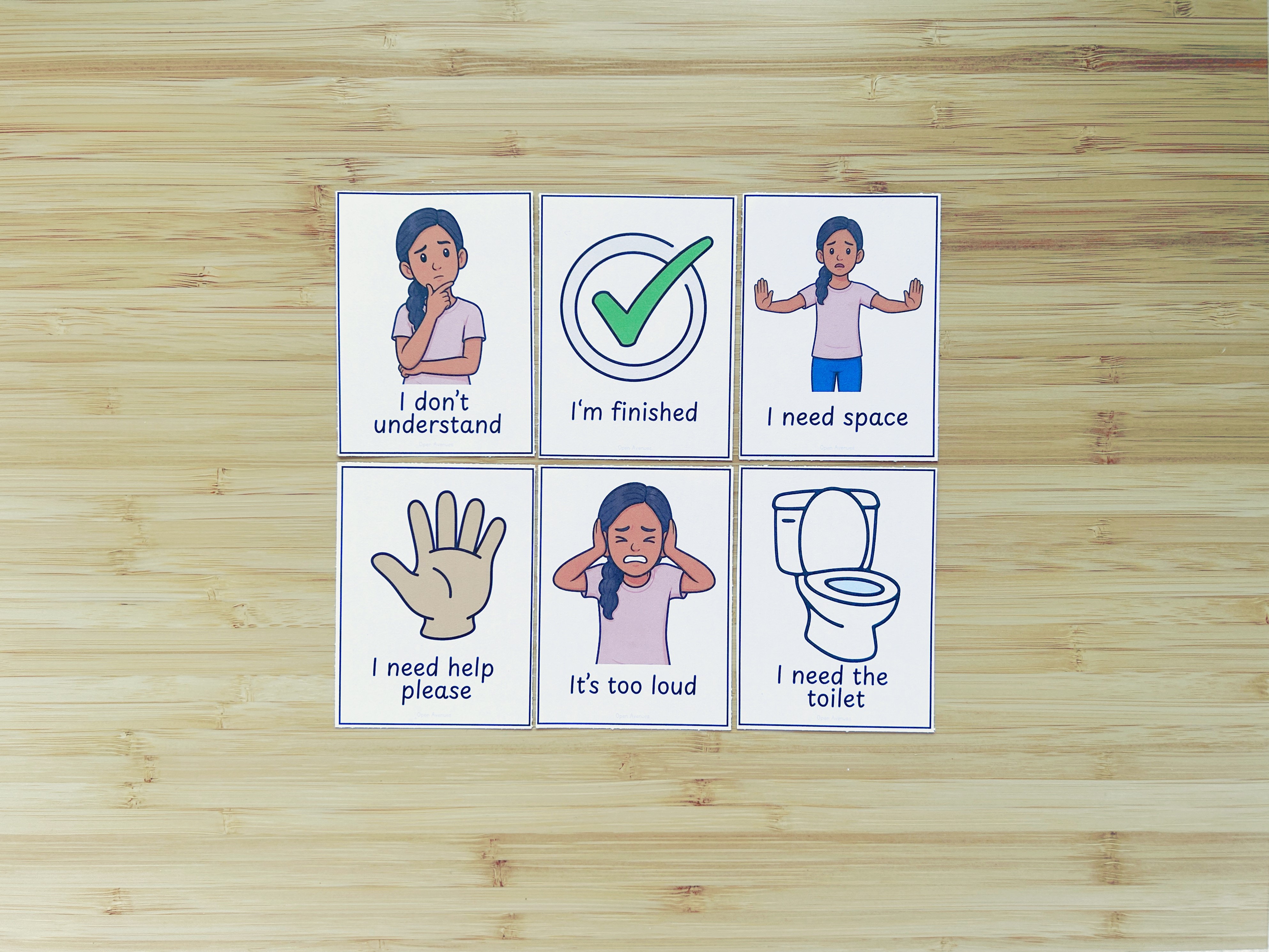
Another way to communicate, straight away. For a child who is not yet speaking, we introduce pictures, signing or a device from the start. Waiting for speech leaves a child with no way to be understood in the meantime. A review of the research found no evidence that these systems hold speech back, and some children's speech increased (although the gains were modest, and the studies small) (Millar, Light and Schlosser, 2006).
Working alongside speech and language therapy. Where a speech and language therapist is involved, we follow their plan. What we can add is a teaching method, particularly when a child is not progressing based on what is currently in place.
Picture exchange systems are a good example. The evidence behind them is solid, and when they fail it is usually the teaching that has gone wrong, not the system. The standard approach starts with a lot of hand-over-hand prompting, which some children refuse. Where that happens, we break the first step down further, perhaps starting with a tap on a symbol, and shape it from there.
Positive Behaviour Support
Where behaviour is causing difficulties, our plans follow the structure used in Positive Behaviour Support, set out in the Prevent-Teach-Reinforce model (Dunlap et al., 2010). Every plan has three parts.
Prevent
Changing what happens around the child so difficulties arise less often. Predictable routines, warning before change, adults who have built a relationship first, and demands pitched where the child can succeed.
Teach
Building the skills that make the behaviour unnecessary. Asking for a break, saying no, waiting, tolerating a change of plan, and whatever else the assessment shows is missing.
Reinforce
What adults do in the moment, so everyone responds the same way, the child is kept safe, and nobody accidentally teaches that the behaviour works.
How we decide what to teach
From assessment rather than assumption. Depending on the child, that means structured skills assessments such as the VB-MAPP or the ABLLS-R, functional assessment where behaviour is a concern, direct observation, and conversations with the people who know the child best.
Targets are then set with you, in teaching order. Progress is recorded, reviewed, and changed when the data says it is not working.
This is what separates a programme from advice. Advice can be followed for a year without anyone knowing whether it helped.

Talk it through
If you would like to know how this would apply to your child or your setting, arrange a call and we will talk it through.
References
Dunlap, G., Iovannone, R., Wilson, K. J., Kincaid, D., & Strain, P. (2010). Prevent-Teach-Reinforce: A standardized model of school-based behavioral intervention. Journal of Positive Behavior Interventions, 12(1), 9–22. https://doi.org/10.1177/1098300708330880
Millar, D. C., Light, J. C., & Schlosser, R. W. (2006). The impact of augmentative and alternative communication intervention on the speech production of individuals with developmental disabilities: A research review. Journal of Speech, Language, and Hearing Research, 49(2), 248–264. https://doi.org/10.1044/1092-4388(2006/021)
Tiger, J. H., Hanley, G. P., & Bruzek, J. (2008). Functional communication training: A review and practical guide. Behavior Analysis in Practice, 1(1), 16–23. https://doi.org/10.1007/BF03391716