A boy I worked with, aged nine at the time, could identify almost any car key by its make. He knew the fobs, the logos, and the differences between them. At home, he would repeatedly ask adults in the room if he could look at their keys, so he could see the make. In the supermarket, he would walk up to an adult he had never met, and do the same. This was met with uncomfortable stares, and apologies from the parents.
He had been told not to talk to strangers many times, at home and at school. He could repeat the rule back accurately. He still approached strangers in public, and asked for their keys.
At a glance
- Personal boundaries are discriminations, not rules
- Children with SEND face higher rates of violence and abuse
- Teach boundaries as concrete permissions tied to circles
- Use both examples and non‑examples, then rehearse in real settings
- Use modelling to practise the skills in rehearsal situations
This was not a refusal to follow instructions. He had learned to repeat a sentence: "don't talk to strangers". But nobody had taught him the skill, which depends on telling strangers apart from people who are not strangers.
The Department for Education's updated statutory RSHE guidance, published in July 2025, came into force on 01 September 2026. At key stages 1 and 2 it puts more weight on skills alongside knowledge, including being able to communicate assertively and express needs and boundaries. For pupils working significantly below age-related expectations, this needs explicit and purposeful teaching.
Why this happens
Personal boundaries are not a rule to memorise. Instead, they are a discrimination, in the technical sense: the ability to respond differently to two things that look similar. "Adult who may help me get dressed" and "adult who may not" are physically indistinguishable categories; there is nothing inherent that would help you differentiate these. A child has to learn to categorise by sorting, and sorting is taught with concrete examples, not verbal rules.
"Don't talk to strangers" fails for three reasons. The category is abstract and cannot be seen. Most strangers a child meets are perfectly pleasant, so the child's own experience contradicts the rule. And the risk sits largely in the wrong place, because harm to children far more often comes from people already known to them, which is exactly the group the rule marks as safe.
This matters more for our learners than for their peers. A WHO-commissioned review published in the Lancet pooled 17 studies covering 18,374 children in high-income countries, the UK among them. Children with disabilities were 3.7 times more likely to experience violence of any kind, and 2.9 times more likely to experience sexual violence than non-disabled children. For children with intellectual impairment or mental illness the figure for sexual violence rose to 4.6 times (Jones et al., 2012).
Personal boundaries are not a rule. They are a discrimination: the ability to respond differently to two things that look similar.
There is a reasonable evidence base for teaching safety skills directly through behavioural skills training, which is instruction, modelling, rehearsal and feedback, followed by practice in the real setting. What is clear from that literature is the part parents and educators often skip - children who could describe the correct response while sitting in a classroom, often did not perform it in the real situation, until they had practised in the real situation.
How to teach it
Sort the people before you teach any rules
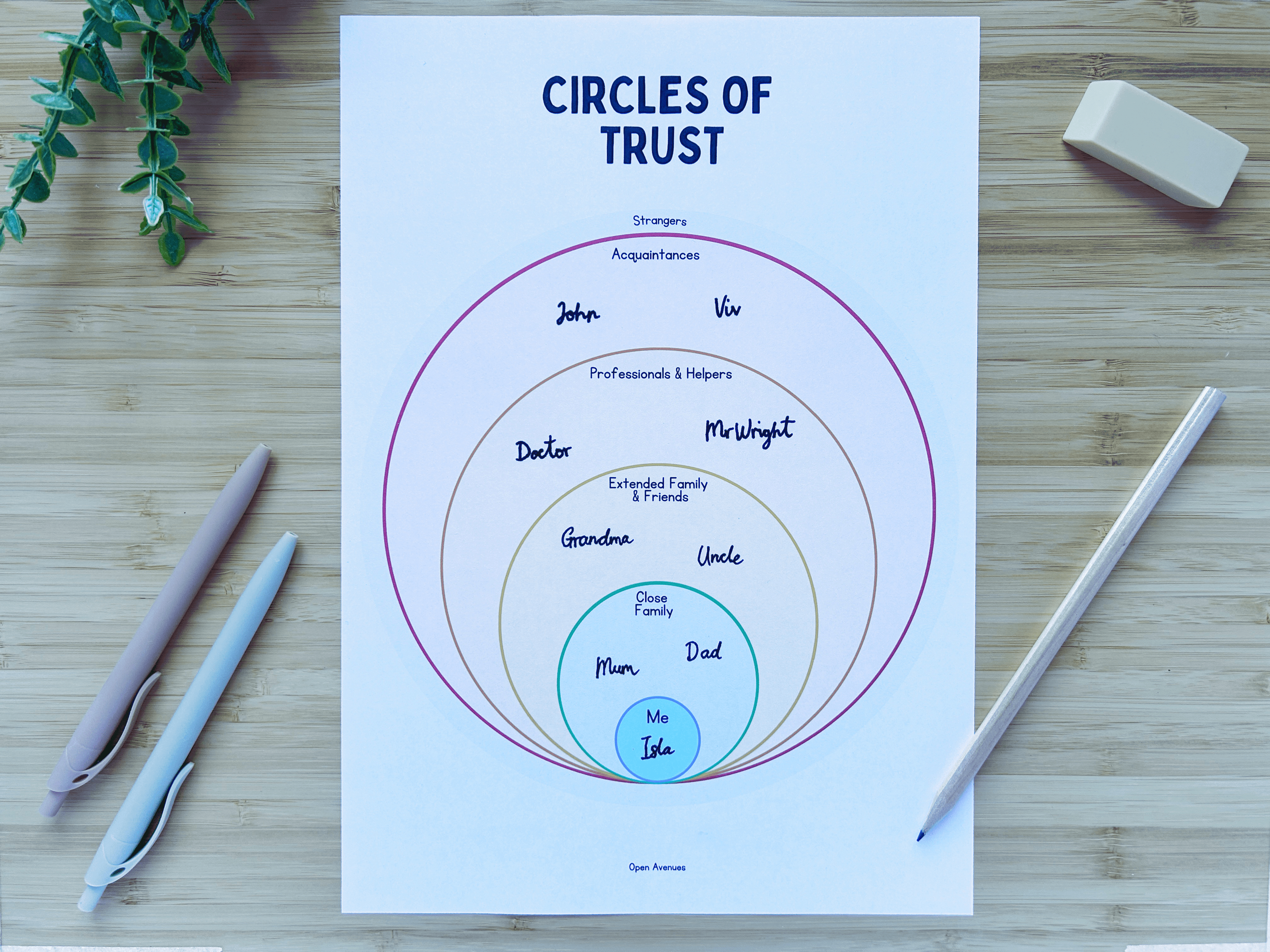
Take photographs of the actual people in the child's life. This is crucial - not clip art, not a generic image of a doctor. Their mum, their nan, their Teaching Assistant, their swimming instructor, the man behind the counter at the corner shop. Photos of real people should be used to teach the child to label 'stranger'. Sort those photographs into circles working outwards from the child: close family, wider family and friends, professionals and helpers, acquaintances, and strangers/people we do not know.
Do this before you introduce a single rule about touch or privacy. The categories have to be real and the child needs to have a meaningful understanding of how to differentiate them, before they can do any work. Make sure the child can answer "who is your close family?" and "who is your acquaintance?" with real example from their life. This takes some coordination and communication between home and school, to make sure these are accurate. If five 'circles' is too many to start with, use two, the child and everyone else, and split from there once the sort is secure.
Attach one observable behaviour to each circle, not a feeling
"Who can we trust?" is abstract, and not meaningful. "Who can help me in the bathroom" is. Pick concrete, observable permissions, and take one circle at a time. Who helps me change for PE? Who I can hug? Whose keys can I look at? Add new rules one by one, only when the child is confident at discriminating the previous rule.
Teach with non-examples as well as with examples
Half your teaching trials should be people where it would not be safe or appropriate for them to engage in that behaviour. If every example the child sees is a correct one, they will learn to say yes to everything, which is the behaviour you started with. "Can the man from the corner shop take you in his car?" No. "Can our next door neighbour help you shower?" No. This is the concrete lesson that is most crucial for safeguarding our young people.
Rehearse rather than discuss
Set the situation up and practise the response. An adult approaches and asks for a hug, and the child practises what they actually do and say. Model it first, let them do it, tell them specifically what went well. For someone appropriate, the child should respond with a hug. For someone from a circle where this would not be appropriate, they should be taught a response such as "no thank you".
This is the step that often gets skipped, and it is the one that solidifies the concept. If a child can label the circles correctly but still approaches strangers, that is almost always a rehearsal problem rather than a comprehension problem.
Keep the circles current
Circles change. A new stepparent, a new one-to-one, a friend's family the child now stays with. If the photographs are twelve months out of date, the child is working from a map that no longer matches the territory. Review them each term, and immediately after any change at home.
If every example the child sees is a correct one, they will learn to say yes to everything.
What progress looks like
The measure is not whether the child can complete the sorting activity with the photographs they were taught on. It is whether they respond correctly with a person they have never seen before. Introduce a new photograph, or better, a new real person, and see whether they respond correctly during a rehearsal.
This should be taught across several weeks of short, frequent sessions, rather than in one PSHE lesson. Five minutes daily beats forty minutes on a Friday. The progress we would aim to see would be accurate sorting first, correct verbal responses second, and correct behaviour in the moment last.
This is skills teaching, not a safeguarding procedure. If a child discloses something during this work, and it does happen, that goes straight to your DSL under your setting's Keeping Children Safe in Education procedures.
Materials
You can gather these materials yourself with a phone camera, a printer and five paper plates. Having written or typed 'rules posters' can be helpful as a visual cue, to help the child remember the circle rules.
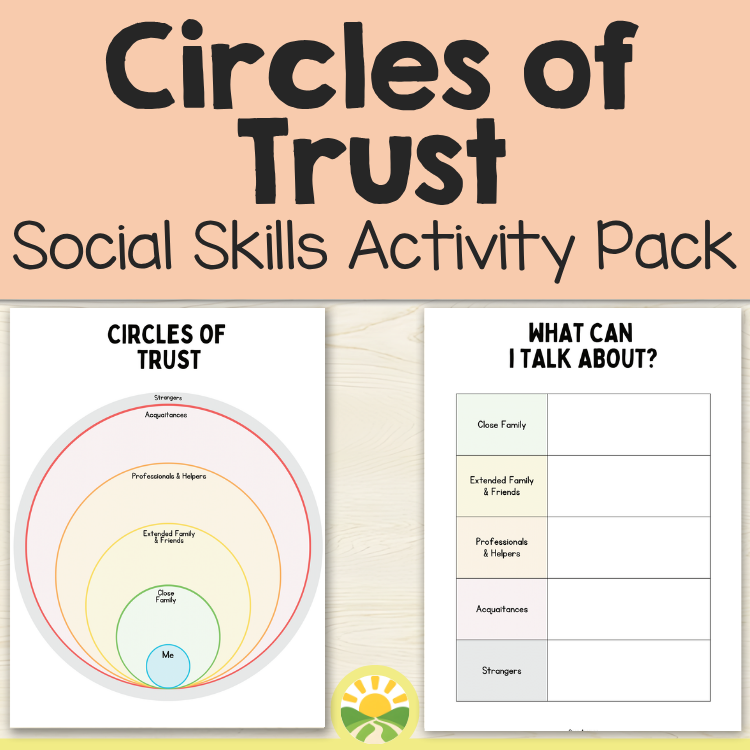
I created this activity pack to support the skill. It has a teaching guide with suggested rules to teach, templates for circle posters and rules posters. Either use the prescribed category names, or use the editable versions to create your own. Circles of Trust, available on Teachers Pay Teachers.
Save this for later

Emily Goyen is a Consultant Behaviour Analyst and Clinical Lead at Open Avenues, working with children with SEND at home, in school and in the community across the Midlands. She holds an MSc in Applied Behaviour Analysis with Distinction and has published peer-reviewed research on handwriting instruction. Emily supports schools and families with functional behaviour assessment, behaviour support planning and individualised teaching programmes. Her school work includes adapting personal safety and RSHE content for pupils working well below age-related expectations. Get in touch.
References
Jones, L., Bellis, M. A., Wood, S., Hughes, K., McCoy, E., Eckley, L., Bates, G., Mikton, C., Shakespeare, T., & Officer, A. (2012). Prevalence and risk of violence against children with disabilities: a systematic review and meta-analysis of observational studies. The Lancet, 380(9845), 899–907.
Department for Education (2025). Relationships Education, Relationships and Sex Education (RSE) and Health Education. Published 15 July 2025, in force from 1 September 2026.